OOH / DOOH campaign measurement
Before, during
and after
How to connect audience forecasting, actual delivery verification and post-buy analysis in one measurable cycle.
Go through the three stages↗Where is the right audience?
Is delivery meeting the agreed conditions?
What did the campaign actually deliver?
One campaign — three sets of decisions
Pre-buy, verification and post-buy should not be assembled from different cases. Across all three stages, the identifiers, period, Universe and contact basis must remain consistent.
- Objective
- Balance reach and repeat exposure
- Period
- 4 weeks
- Planning
- OTS, Reach 1+/3+, Frequency
- Verification
- Inventory, creative, period, monitoring
- Actual
- Same basis and same Universe
- Disclaimer
- This example illustrates the logic, not a client's result
Compared incremental reach and duplication, not just the number of screens.
Matched inventory, creative, dates and available evidence.
Recalculated metrics for the actual period and documented the reasons for deviations.
Where and how to place
Pre-buy is a scenario-based estimate of a future campaign. It helps select an inventory plan, but it does not guarantee the actual result.
Where and how should we place to reach the right audience?
Inventory potential
OTS/LTS, time patterns, audience profile and each asset's contribution.
Reach and Frequency
Reach 1+/N+, repeat exposure and the risk of over-concentrating on a narrow core audience.
Overlap
Audience duplication and incremental reach from adding a new asset.
Budget and SOV
Compare periods, operating hours, duration, ad loop and share of available time.
More screens do not always mean more new people reached
Two plans may generate a similar volume of potential contacts but very different unique reach because audience routes overlap.
Is the campaign going to plan?
At this stage, the goal is to identify deviations early enough to fix the schedule, replace a file, restore an asset or agree on compensation.
Is the campaign running as planned?
Creative, assets, dates, number and timing of plays
Fix the schedule or replace the fileUptime, operating hours, outages, image quality
Escalate or redistribute playsSOV, loop, pacing and placement geography
Change pacing, share of time or inventory mixCoverage, delays, anomalies and incomplete periods
Pause interpretation and flag the affected windowMonitoring links video evidence to the asset, date and location
In AdCheck, materials can be filtered by geography, period, screen, category and brand; you can then open the video and verify the asset metadata.
Interface: METER AdCheck user guide. Monitoring complements campaign audience measurement but does not replace it.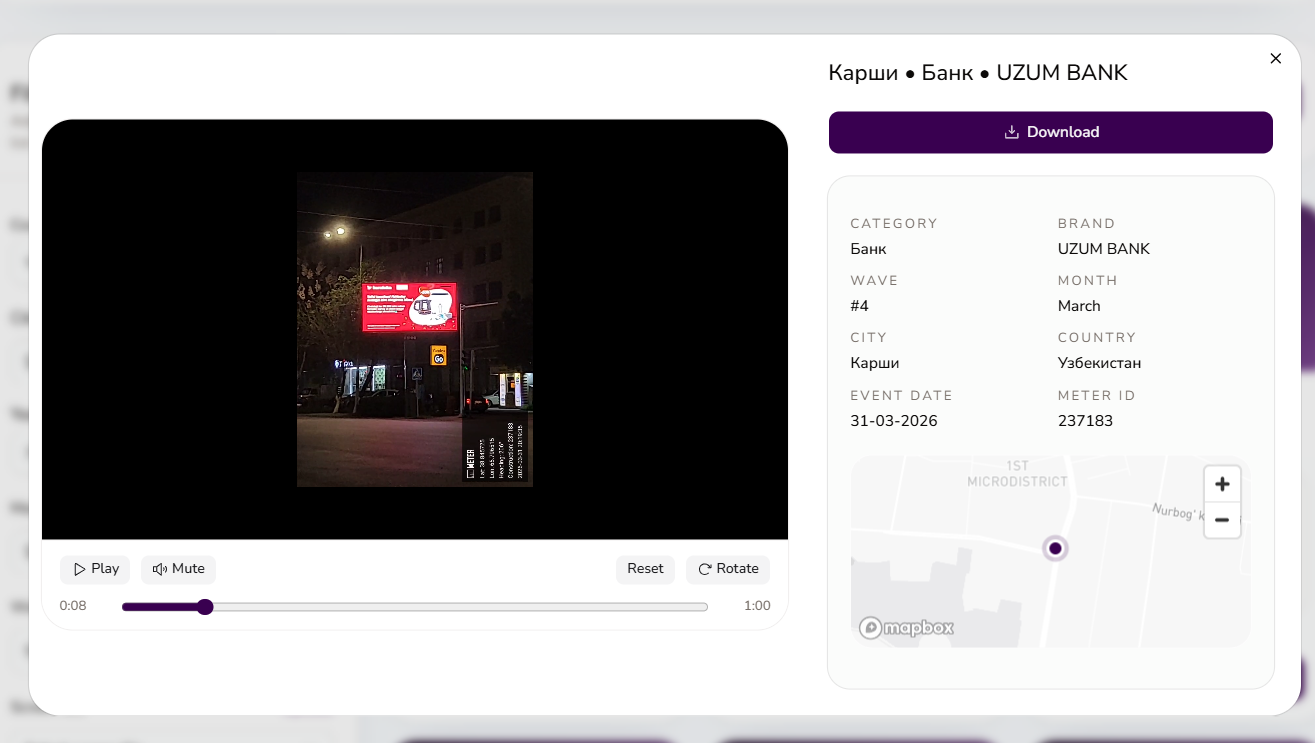
What audience did the campaign deliver?
Post-buy combines actual placement parameters with audience data. Its purpose is not to repeat the forecast, but to explain the final result and the gaps.
What audience did the campaign actually deliver?
OTS / LTS
Actual contacts calculated on a clearly stated basis.
Reach 1+ / N+
Unique reach and repeat exposure.
Frequency
Average frequency and contact distribution.
GRP / TRP
Result relative to the selected Universe.
Contribution and overlap
The role of individual assets and audience overlap.
Plan vs actual
Reasons for deviations and recommendations.
Tashkent · June 2026
Two digital assets. Metrics are shown on both OTS and LTS bases; the period and inventory composition are stated next to the result.
Source: sample METER report from the methodology guide.Same geography, audience and statistical base
Compare OTS with OTS and LTS with LTS
Planned and actual periods normalized by days and hours
Account for uptime, replacements, SOV, underdelivery and available PoP
What exactly does the data confirm?
Verification, Proof of Play, Measurement and Attribution are related, but they answer different questions. PoP is one piece of evidence within the verification framework, not audience measurement.
Verification
Was the ad placed correctly, on the right assets and during the right period?
Proof of Play
Is there a verifiable record of a specific playback event?
Measurement
How many contacts and unique people did the campaign deliver?
Attribution
What actions happened after exposure, and can the relationship be substantiated?
What the client should receive
The final package should make it possible to verify delivery, understand the audience and use the findings in the next media plan.
Actual delivery
Inventory mix, period, uptime, replacements, underdelivery and compensation.
Evidence
Available PoP records, monitoring materials and deviation log.
Post-buy
OTS/LTS, Reach 1+/N+, Frequency, GRP/TRP and asset contribution.
Plan vs actual
Comparison on the same basis, with an explanation of the reasons for deviations.
Methodology profile
Universe, sources, calculation rules, limitations and excluded periods.
Next step
Recommendations for a new inventory plan and the next measurement cycle.
Ten checks before drawing conclusions
If even one item is not aligned, the gap between forecast and actual may be caused by an incomparable calculation basis rather than by the campaign itself.
- 01
Same Universe and target filters
- 02
One contact basis: OTS with OTS, LTS with LTS
- 03
Comparable period, days, hours and time zone
- 04
Actual assets and creative identifiers
- 05
SOV, loop and spot duration
- 06
Uptime, outages, replacements and compensation
- 07
Availability of Proof of Play and monitoring
- 08
Same methodology and source version
- 09
Separate measurement from attribution
- 10
Reasons for deviations and actions taken
OOH/DOOH campaign checklist
Short version for briefing, interim verification and post-buy acceptance.
Practical questions
The main questions that arise when moving from the media plan to campaign verification and final measurement.
01Can an OOH campaign be measured in real time?+
Ad delivery and screen operation can often be monitored close to real time. Audience metrics are updated with a delay depending on data sources, quality control and methodology.
02Does Proof of Play confirm that the ad was seen?+
No. PoP confirms a playback or placement event. Human presence, potential contacts, unique Reach and attention are measured separately.
03Why does actual Reach differ from the forecast?+
Results are affected by the actual period, uptime, SOV, replacements, underdelivery, changes in mobility, data coverage and the actual inventory mix.
04Can OTS in pre-buy be compared with LTS in post-buy?+
No. Plan and actual must be compared on the same contact basis. OTS is compared with OTS and LTS with LTS, using the same Universe and time window.
Sources
- MRC Out-of-Home Measurement Standards — Phase 1 & 2 Combined Final, December 2025.
- WOO Global OOH Audience Measurement Guidelines 2.0, June 2026.
- IAB Digital Out-Of-Home Measurement Guide, July 2025.
- METER: methodology for measuring OTS, LTS, Reach and audience characteristics.
- METER AdCheck: user guide.
This material explains the measurement methodology and does not constitute a claim of MRC accreditation, WOO certification or an independent audit of METER.